Here’s a spicy truth bomb: the 2026 Silverado might be the most important Chevy truck you’ll never brag about on Instagram. This is the calm before the V8 storm, the last deep breath before GM unleashes its next-gen small-block theatrics, and that makes this 2026 Chevy Silverado review weirdly fascinating. I’ve driven dozens of full-size trucks, and this one feels like a veteran boxer keeping fit while waiting for one last title shot.
Why should you care right now? Because if you want a proven, old-school V8 truck without beta-testing new powertrains, the 2026 Silverado is your safe harbor. Ford’s F-150 is flirting with turbo-everything, Ram’s 1500 is mid-reinvention, and Toyota’s Tundra is still ironing out its twin-turbo confidence. Chevy, for better and worse, is sticking to its guns.
Consider this 2026 Chevy Silverado review a pub chat about what’s actually new, what’s suspiciously unchanged, and whether this truck deserves your money before the next-gen V8 era arrives with a corporate PowerPoint and a choir of PR buzzwords.
Quick Specs
- Starting Price: approximately $38,000 (check manufacturer website for latest pricing)
- Engines: 2.7L Turbo I4 / 5.3L V8 / 6.2L V8 / 3.0L Duramax Diesel
- Power: 310–420 hp / up to 495 lb-ft
- 0-60 mph: as quick as 5.4 seconds (6.2L V8)
- Fuel Economy: up to 23 city / 29 highway mpg (diesel)
Design & First Impressions
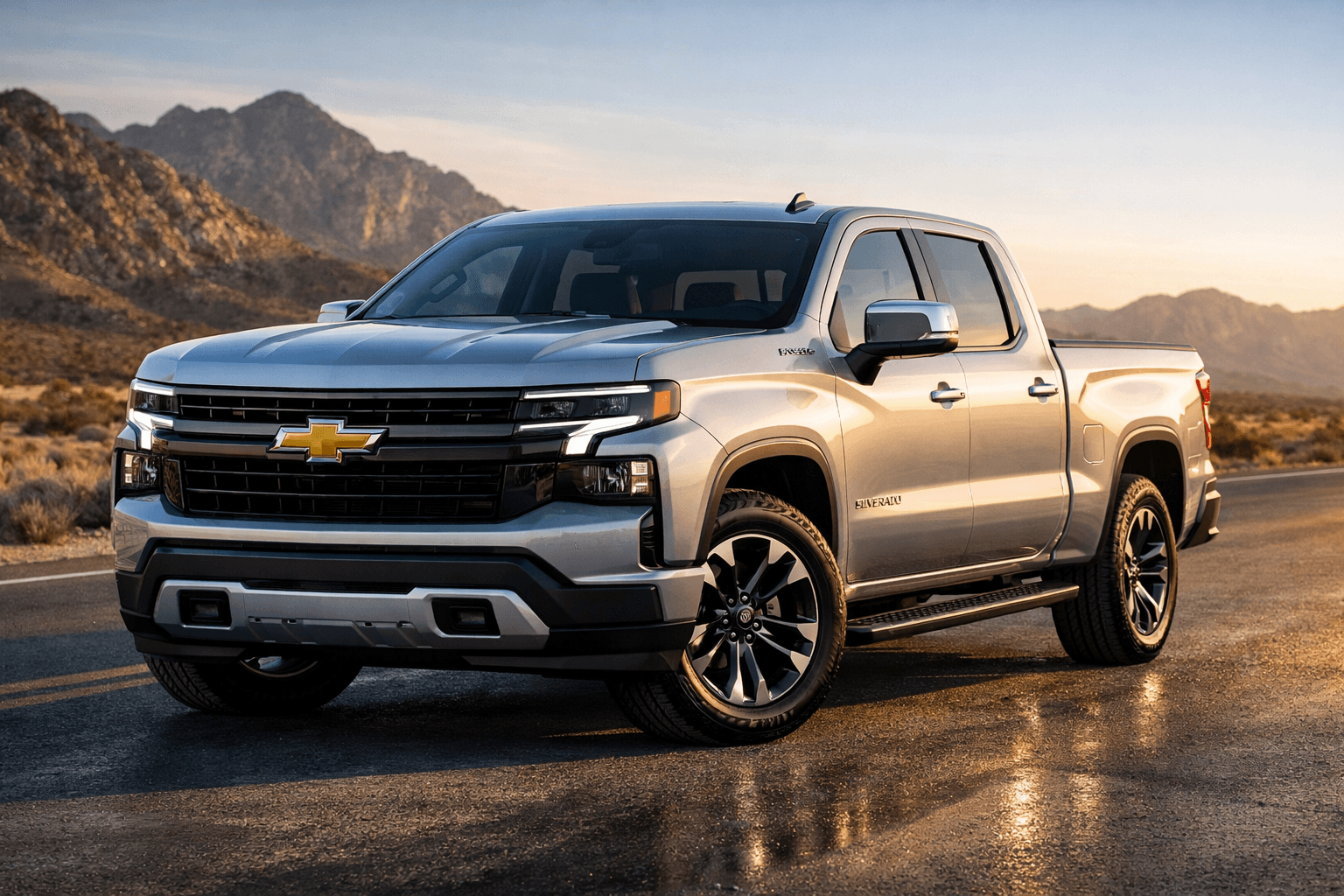
The 2026 Silverado looks familiar because, frankly, Chevy didn’t want to mess this up. The updates are subtle: revised grille textures, a slightly meaner LED signature, and new wheel designs that scream “SEMA parking lot” rather than “corporate fleet.” Park it next to a GMC Sierra and you’ll still notice the Silverado’s more honest, work-boot vibe.
Hot take: I like that Chevy resisted the urge to go full spaceship. While the Ford F-150 keeps adding light bars like it’s auditioning for TRON, the Silverado looks like a truck that knows what a torque wrench is. Ram fans will call it conservative; I call it confident.
Interior & Tech
Inside, the Silverado finally feels like it’s caught up to 2026. Higher trims get a 13.4-inch touchscreen paired with a 12.3-inch digital cluster, and the Google Built-In system is genuinely excellent, even if it knows more about my driving habits than my spouse. Apple CarPlay and Android Auto are standard, unlike certain EV brands having an identity crisis.
The materials still lag behind Ram’s borderline-luxury cabins, but the layout is idiot-proof. Physical knobs for volume and climate remain, which earns Chevy a standing ovation from anyone who’s screamed at a touchscreen on a washboard trail. Doug DeMuro would call this a “quirk,” and he’d be right.
Driving Experience
Let’s talk engines, because that’s the Silverado’s party trick. The 5.3L V8 (355 hp) is the Goldilocks choice, while the 6.2L V8 (420 hp, 460 lb-ft) turns this truck into a drag-strip meme, ripping to 60 mph in about 5.4 seconds. Throttle response is immediate, not lazier than a cat in a sunbeam like some turbo rivals.
The real MVP remains the 3.0L Duramax diesel with 495 lb-ft of torque. It tows effortlessly, sips fuel, and makes the Ford PowerBoost hybrid feel like it’s trying too hard. Steering is still trucky, but body control is solid, especially compared to the Toyota Tundra’s slightly jittery rear end.
Fuel Economy & Running Costs
EPA figures put the diesel at up to 29 mpg highway, which is absurd for something this size, according to FuelEconomy.gov. The 2.7L TurboMax four-cylinder manages around 20/22 mpg, but here’s my controversial take: it feels out of place in a $50k-plus truck.
Maintenance costs are predictable, parts are everywhere, and every mechanic in North America knows this platform. That matters more than a flashy hybrid badge when you’re 150 miles from home with a trailer full of bad decisions.
Practicality & Towing
Towing maxes out around 13,300 pounds when properly equipped, which keeps the Silverado squarely competitive with the F-150 and Ram 1500. Bed lengths, cab configurations, and trim levels are as varied as craft beer taps, so there’s something for contractors and weekend warriors alike.
If you’re debating drivetrain setups for winter hauling, our deep dive on AWD vs 4WD in winter is worth a read. Short version: get 4WD, decent tires, and don’t be a hero.
Value vs Competitors
This is where the 2026 Chevy Silverado review gets spicy. Against the Ford F-150, Chevy wins on engine feel and loses on interior pizzazz. Versus the Ram 1500, it’s tougher but less plush, and compared to the Toyota Tundra, it feels more mature and less experimental.
Pricing creeps quickly with options, but resale values remain strong. The Silverado doesn’t wow you in one specific area; it just refuses to annoy you over time, which is a criminally underrated trait.
What’s New Before the Next-Gen V8 Era
Chevy’s biggest update is actually restraint. Minor tech refinements, expanded driver-assist availability, and incremental quality improvements signal GM is saving its fireworks. Think of the 2026 model as a director’s cut of a movie you already liked.
This approach mirrors what we’ve seen with other brands preparing for powertrain shifts, much like the farewell vibes discussed in our 2026 Lexus LC review. Sometimes, the last of the old guard is the one you want in your garage.
Pros
- Excellent V8 and diesel engine options
- Proven reliability and massive parts availability
- User-friendly tech with real buttons
- Strong towing and resale value
Cons
- Interior still trails Ram for luxury
- Turbo four-cylinder feels uninspiring
- Options inflate pricing quickly
Verdict
The 2026 Chevy Silverado review boils down to this: it’s not the flashiest truck, but it might be the smartest buy right now. Check specs and trims on the official Chevrolet website, and don’t forget to glance at safety ratings on NHTSA.gov. Buy one, and you’re not chasing trends—you’re banking on muscle memory, and sometimes that’s the most rebellious move of all.